Visiting and more about Wy’east UU
The Wy’east Unitarian Universalist Congregation is a spiritual community in Portland, Oregon, affiliated with the Unitarian Universalist Association (UUA). As a UU congregation, we are a welcoming community that draws from many sources of wisdom, including nature, science, philosophy, and various religious traditions. We covenant together as a community of love, aspiring to become our deepest and truest selves.
We meet for worship every Sunday at 10:30 AM. All of our services are multi-platform, giving you the flexible option to attend either In-Person or online via Zoom. We meet in-person at the Center for Positive Aging at 1820 NE 40th Ave. You can find details about upcoming topics and the Zoom link on our Upcoming Worship Services page. Learn more about visiting on our Plan a Visit page.
We meet in the Hollywood Neighborhood of East Portland. If you are taking public transit, the neighborhood is conveniently served by three TriMet Bus Routes: #12, #75, and #77, as well as the Hollywood MAX Station. If you drive, street parking within a few blocks is plentiful. The parking lot directly behind the Senior Center is a pay lot. We strongly recommend not parking in the lot across 40th Ave, as you could be towed.
Learn more on our Plan a Visit page.
Dress at Wy’east is completely casual. You will see some people in a dress or a suit, others in jeans, and some in shorts and a t-shirt. Wear whatever makes you feel comfortable!
When you arrive, our greeters will welcome you at the door. Please let them know you are visiting for the first time so we can help you get oriented. During worship, we sing together, read inspiring texts, light candles, share joys and sorrows, meditate in silence, and listen to a sermon from our minister or a guest speaker. Afterward, please stay for coffee, treats, and conversation at our social hour.
For the well-being of the community and out of respect for one another, masks are
always welcome and not uncommon at Wy’east UU. One of the benefits of offering Multi-platform worship is that you can always attend online if you are feeling ill.
Yes! We are an open, religious community for people of all ages. If you have young children, they are welcome to join our Religious Exploration classrooms to make friends and learn. Fully trained service animals are also completely welcome to sit with you during our worship services.
We are a radically welcoming congregation. Our guiding principle is stated in our chalice lighting words: Whoever you are, wherever you come from, you are welcome here. We welcome all people who share our values regardless of: Race, color, or national/ethnic origin, gender or sexual orientation, age or economic background. We look forward to meeting you.
Our lay-led Worship Committee is charged to create a varied, meaningful, robust, and rooted-in-spirit calendar of worship services. They are guided by the mission of our congregation and the values of Unitarian Universalism. We don’t just hear from ministers or professional speakers. We invite lay speakers from a wide range of backgrounds and lived experiences such as educators, chaplains, activists, organizers, artists, caregivers and more to share their wisdom and inspiration. You can learn more about Worship on our Who Leads Worship page and can scroll through our Sermon Archive to get a feel for the kinds of services we offer. We publish our upcoming worships towards the end of the previous month (for example in late June for the month of July).
Anyone is welcome to attend services and participate in our activities as a non-voting “Friend” of the church for as long as they like. When you feel ready to take the next step, the path looks like this:
1) Be a regular: Attend services, sign up for a permanent nametag, and volunteer for things you enjoy (like serving coffee or helping set up).
2) Attend a class: Join our “Path to Membership” class, held every few months, to learn how Wy’east operates.
3) Commit and sign: Make a confidential annual financial pledge of any amount that fits your budget, and sign the Wy’east Membership Book during a Sunday New Member Ceremony.
Because we operate as a democratic organization, becoming an official member gives you a vote in all congregational matters and the right to run for our Board of Trustees.
We live by a congregational covenant that states: We covenant with each other as a community of love. We will become our deepest and truest selves together. We will be cared for, and we will be called on to care for others. The purpose of our gathering is to find spiritual community, be filled with inspiration, find comfort in friendship, and carry our shared vision into the wider world. You will find these ideas permeate all aspects of our congregation.
Wy’east UU seeks to be attentive to accessibility. Some of the ways we do that are:
– We offer all of our worship services via Zoom so that homebound and out- of-state members may regularly attend.
– Our in-person meeting site is a fully accessible building (with no steps) and includes ADA restrooms and a single-user restroom.
– We offer captions on screen via the Zoom platform transcription service.
– We have large print hymnals available by request.
Learn more about our commitment to accessibility on our Location & Accessibility page.
Unitarian Universalism has a long history of commitment to social justice work. It’s one of the reasons that people become members of a congregation like ours. But it is not enough to just make a gesture in the direction of a particular issue. It’s getting involved in some way that makes a difference to Wy’easters — by bringing it to life.
Social Justice and service work at Wy’east take a number of forms, and there are several ways members participate. These include participating in one of our community presence projects, contributing to the Social Justice Committee’s work, and organizing or participating in a Fifth Sunday Service Project. We have A LOT of specific information about all of these on the Social Justice pages of our website. In addition, Wy’east members are involved in a wide array of social justice work in their personal lives.
– Sunday set up/take down: Chairs, signs, hospitality, etc. are set out from 9:30-10:15. Come and join us any Sunday. Ask a setup person if you’d like to be a regular helper.
– Potluck Sundays are the first Sunday of the month immediately following the service. Everyone brings food and helps to set up/take down tables and chairs.
– Snacks for Social Hour: A basket is set out on the snack table on Sundays to collect $ donations; or sign up on the clipboard on the table to help provide snacks.
– Kitchen Duty: Coffee, tea, and snacks are set out for Social Hour and everything is cleaned up afterwards. Pitch in either before or after a service and make new friends.
– Ushering/Greeting: Ushers set up the welcome tables with tablecloths, brochures, nametags, etc. They welcome visitors, pass the collection boxes, tabulate the collection, and count attendees. Contact an usher if you’d like to help.
– Religious Exploration: Volunteers help with the children in RE or nursery care, or are on our “on-call” list. Please contact our Director of Religious Exploration to learn how you can contribute.
Yes! Wy’east has a number of small groups and gatherings on a regular basis. These include a book group, a Chalice Circle, the Men’s Group, and the Social Justice Team. Check the Calendar and see the Small Groups for Adults page on our website to learn more.
The Wy’east budget pays for our staff (our part-time Minister, Administrator, Director of Religious Education and Tech Support Person), our building costs, and more. Our income comes from our members and friends. Each spring we ask for a pledge from Wy’east families. This is called our “Canvass.” A pledge is a promise to contribute an annual amount, paid monthly. Paid pledges make up 95% of the Wy’east budget. The other 5% comes from the Sunday cash collection and fundraisers.
Pledges are made in the spring and are effective during the fiscal year from July 1 through June 30. Monthly pledges range from under $10 to several hundred dollars. Wy’east UU is a 501(c)3 organization and contributions qualify as charitable itemized deductions.
Learn more about giving to Wy’east on our Donate page.
As Unitarian Universalists, we support the use of inclusive democratic processes to make decisions both within our congregations and society at large. We hold our annual congregational decision-making meeting in May of each year. At that meeting we elect members to a Board of Trustees and discuss/approve our annual budget. Periodically, we hold Congregational Meetings to discuss issues. Members and visitors may participate, but only members vote.
Our 5-member Board of Trustees is entrusted with the responsibility for the development, management and application of policies and procedures. They meet monthly and serve staggered 2 year terms. Our current board members are listed on our About page.
We utilize nametags at our In-Person Worship services. You can sign up on the Nametag clipboard at the Welcome Table. After a week or two, pick up your nametag, then choose and attach a colorful lanyard and your choice of preferred pronoun stickers.
Members and friends are listed in the directory upon request. The directory is only distributed to people who are listed therein. If you want to be listed, need to change something in your listing, or want an updated copy, contact us via email at office@wyeastuu.org.
Wy’east has two email distribution lists; links to sign up for either are on our News page.
– The Newsletter list is used to send out Service Announcements (what is happening this week) once per week. In addition, we send a monthly newsletter. Anyone can join this list.
– We also offer a listserv-style group called “the chat” where members and friends can share items of interest or seek help with something. Traffic on this listserv is fairly light (usually 5-10 emails a week). Requests to be added to this list are approved by a moderator.
About Unitarian Universalism (UU)
Unitarian Universalism (UU) is a liberal religious tradition centered on theological diversity, inclusivity, and social justice. We are a “creedless” faith, meaning we do not require our members to sign onto a specific religious dogma or single set of doctrines. Instead, we are unified by a shared covenant—a promise of how we will treat one another and work together in the world.
Because we value intellectual and spiritual freedom, the personal beliefs of individual UUs range widely. In our congregation, you will find people who identify as humanists, agnostics, atheists, Christians, Buddhists, Jewish UUs, pagans, and spiritual seekers of all kinds. We believe that personal experience, conscience, and reason should be the final authorities in religion, and we draw inspiration from all the world’s major faith traditions. At Wy’east, we often think of this question as what do Unitarian Universalists practice rather than believe.
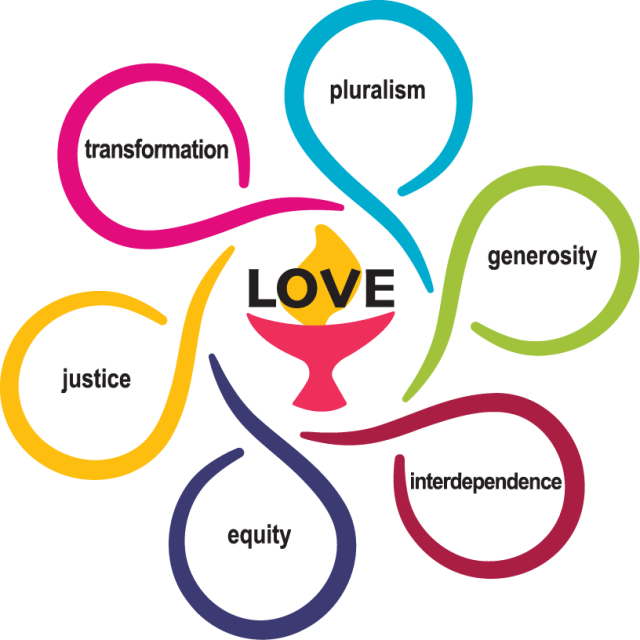
n June 2024, the Unitarian Universalist Association (UUA) democratically voted to anchor our living tradition around Love, expressed through six deeply interconnected Shared Values:
Interdependence: We honor the interdependent web of all existence.
Pluralism: We celebrate that we are all sacred beings, diverse in culture, experience, and theology.
Justice: We work to build diverse, multicultural “Beloved Communities” where all can thrive.
Transformation: We open ourselves to adapting and growing in a changing world.
Generosity: We cultivate a spirit of gratitude and hope.
Equity: We declare that every person is inherently worthy and has the right to flourish with dignity.
Historically, yes, but today, no. While Unitarian Universalism (UU) grew out of two progressive Christian denominations (Unitarianism and Universalism), it evolved in 1961 into a distinct, non-creedal religion. This means UU does not require members to hold any specific religious beliefs or doctrines.
Today, Unitarian Universalism is a theologically diverse faith that draws inspiration from many sources. While some UU members identify as Christian or follow Jesus’s teachings, many others identify as atheists, agnostics, Buddhists, pagans, or humanists. Everyone is welcome to join, regardless of their personal belief system.
Yes! Unitarian Universalism offers individuals the opportunity to be spiritual and religious without the need to declare fealty to a god whose existence they may doubt.
The Unity Church and Unitarian Universalism (UU) are both open-minded, progressive spiritual communities, but they differ in their core beliefs. Unity is a metaphysical Christian movement focused on positive thinking and individual spirituality. Unitarian Universalism is an inclusive, non-creedal tradition that draws on many world religions and focuses heavily on social justice. Unitarian Universalism does not require belief in a single concept of God or adherence to any doctrine. In contrast, the idea of God or a divine presence is foundational in the Unity Church. This is just a small piece of the whole picture, and we invite you to explore further if you are interested in learning more.
Wy’east was formed in 1996 by a group of First UU Church members, who had a desire for a small, diverse East Portland church with a strong sense of community. From it’s founding, Wy’east has centered families and multi-generational community as well as Social Justice. Visitors often tell us that we exude a warm welcome and that Wy’east is a size where you can be known and seen. For many, the decision about which UU congregation suits their needs is rooted both in geography and what it feels like to walk in the door.
The flaming chalice is the primary symbol of Unitarian Universalism. It was created during World War II by Austrian artist Hans Deutsch. Deutsch worked with the Unitarian Service Committee (USC)—a humanitarian group—to design an official, recognizable logo for documents used to rescue refugees escaping Nazi persecution. The chalice—a cup on a stem—and its flame were chosen to represent sacrificial love, helpfulness, and sanctuary. Since its inception, the symbol has evolved into a central part of Unitarian Universalist identity. Most UU Congregations will open their worship services by lighting the chalice.
Wy’east UU FAQ
Our congregation was founded in 1996 by East Portland residents looking for a small, tight-knit, liberal religious community. The name Wy’east comes from a Northwest Native American legend about the regional landscape. The legend tells of a fierce quarrel between two chief brothers, Pahto and Wy’east, over the maiden Loo-wit. The Great Spirit intervened, turning Loo-wit into Mt. St. Helens, Pahto into Mt. Adams, and Wy’east into Mount Hood—the beautiful peak that dominates Portland’s eastern horizon and gives our congregation its strong sense of place.
Modern Unitarian Universalism was born in 1961 from the consolidation of two distinct, historic Christian denominations that had both evolved toward liberal theology:
1) The Unitarians (organized in America in 1825), who rejected the traditional doctrine of the Trinity, asserting instead the unity (oneness) of God and the humanity of Jesus.
2) The Universalists (organized in America in 1793), who rejected the idea of eternal damnation, preaching instead the “universal salvation” of all human souls by a completely loving God.
Over the decades, our faith expanded past its liberal Christian roots to embrace a pluralistic, multi-faith perspective.
Because of our historical emphasis on freedom of thought, scientific inquiry, and social reform, many notable history-makers have been part of our tradition.
– Five U.S. Presidents were Unitarians: John Adams, Thomas Jefferson, John Quincy Adams, Millard Fillmore, and William Howard Taft.
Other historical and contemporary figures include (this list is not intended to be exhaustive):
– Scientists & Inventors: Sir Isaac Newton, Charles Darwin, Alexander Graham Bell, Sir Tim Berners-Lee (inventor of the World Wide Web), Joseph Priestley (discoverer of oxygen).
– Writers & Thinkers: Ralph Waldo Emerson, Henry David Thoreau, Louisa May Alcott, Charles Dickens, Kurt Vonnegut, Ray Bradbury, Beatrix Potter.
– Activists & Humanitarians: Susan B. Anthony (suffragist), Clara Barton (Universalist founder of the American Red Cross), Dorothea Dix (mental health reformer), Whitney Young (civil rights leader).
– Artists & Creators: Frank Lloyd Wright (architect), Christopher Reeve (actor/activist), Paul Newman (actor/philanthropist), Pete Seeger (folk musician), Gary Gygax (co-creator of D&D).
The Unitarian Universalist Association of Congregations, also known as the UUA, is the central organization for the Unitarian Universalist (UU) religious movement in the United States. The UUA’s 1000+ member congregations are committed to inseparable and deeply interdependent shared values of interdependence, transformation, generosity, pluralism, justice, and equity—all centered around love. The mission of the Unitarian Universalist Association (UUA) is to equip congregations for health and vitality, to support and train lay and professional leaders, and to advance Unitarian Universalist values in the world. Each UU congregation is autonomous—congregational leaders set their own priorities and choose their own ministers and staff. Congregations vote for the leaders of the UUA, who oversee the central staff and resources.